Think of all the times in your life when you desperately want to hear YES.
A job interview.
A promotion.
A donation.
A new idea you're trying to get approved.
Moments where your logic is sound, your argument is smart, and the answer should be YES.
But somehow, it isn't.
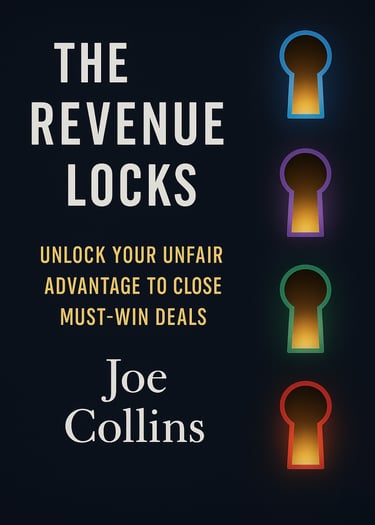
The Revenue Locks | by Joe Collins, Founder of ACES Growth
Before you can increase your odds of getting a YES, you have to understand the psychology of why NO is so much more likely.
Since there are many use cases this applies to, let's call the person you are trying to convince your "buyer." What you're selling may not have a price tag, but you still want them to buy your idea.
In your buyer's brain:
There are two foundational truths you have to understand to get a yes: Buyers don't like change, and they don't like unnecessary risks. This isn't just preference; their brains are wired against both.
That defense shows up as four psychological locks. They're the reason smart ideas get stuck, great candidates get overlooked, and good solutions fall apart.


Relevance Lock
The brain asks: Does this even matter to me right now? If you start with what's true for you instead of what's true for them, this lock clicks tight before you even notice.
Impact Lock
Even if it feels relevant, the next question is: Will this actually work here? Everyone has scars from something that sounded great but failed in real life. Belief only builds when it feels possible in their specific world.
Difference Lock
Once belief starts forming, a new defense shows up: Why you? When everything looks and sounds the same, the brain takes the safest path and does nothing. Real difference is felt, not stated.
Urgency Lock
The final barrier is timing: Why now? Even when everything makes sense, the comfort of later is powerful. People wait until they have to act. Your job isn't to force urgency but to uncover the real clocks already ticking in their world.
Once you understand these four locks, every conversation changes. You stop pushing for YES and start creating the conditions where YES happens naturally.
THE FOUR LOCKS
Every YES has to pass through four invisible locks.
WHERE THIS APPLIES
These locks don't just block deals. They block every decision that matters.
A hiring manager choosing between candidates.
An executive deciding which project to fund.
A donor choosing who to support.
A friend deciding whether to take your advice.
In a Job Interview
Relevance: Do you understand what matters to this company right now?
Impact: Will your success work here, in this culture?
Difference: Why you instead of the other qualified candidates?
Urgency: Are you someone they must hire now or can they wait?
In Leadership and Change
Relevance: Does your team see how this connects to their real work?
Impact: Do they believe it will make things better or just create more work?
Difference: Why this initiative over all the others competing for time?
Urgency: Is there a clear reason to move now instead of next quarter?
In Fundraising
Relevance: Does your cause connect to the donor's personal story?
Impact: Can they see the tangible difference their money will make?
Difference: Why your cause instead of another?
Urgency: Is there an authentic reason to give now?
ABOUT JOE
I'm Joe Collins, founder of ACES Growth and author of The Revenue Locks. I've been studying decision psychology for 30 years.
I have a degree in psychology and spent 18 years in B2B revenue closing multi-million dollar deals, building diagnostic frameworks, and training sellers across six continents. I co-authored The Expansion Sale in 2018, which became required reading at multiple Fortune 500 sales organizations.
Through all of it, I kept seeing the same pattern. Four psychological locks. Same sequence. Predictable.
That became The Revenue Locks framework. The book was written for the B2B sales world, but the psychology applies everywhere someone needs to believe and act.


THE BOOK
The Revenue Locks
The book walks through each lock, the science behind it, and how to open it without pressure or manipulation. If you've ever thought, "We did everything right, so why didn't they say yes?" this will explain why.
SPEAKING
Keynotes and Workshops
I've delivered talks across six continents at team offsites, leadership summits, sales kickoffs, and conferences.
Each talk is customized to the audience using the Locks as the guide: What will be relevant? What will have real-world impact? How is this different than what they've heard before?